

Today we’re going to take a look at the ‘most dangerous woman’ to ever grace the US of A. Typhoid Mary.
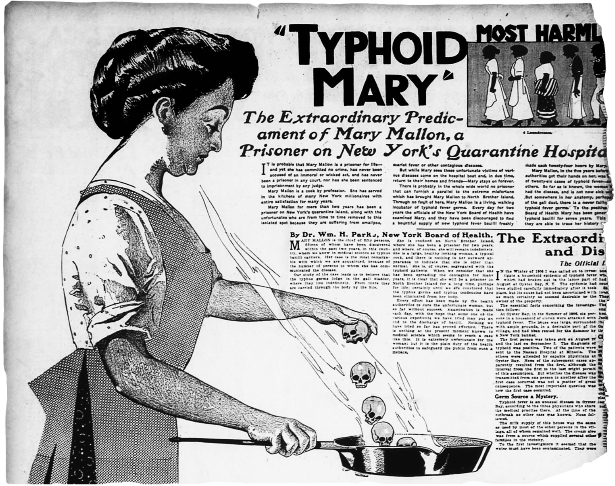
Mary Mallon was born September 23rd 1869 in Cookstown, Ireland. Mallon moved to the States in 1883 at the age of about 14 and moved in with her aunt and uncle, who, resided in New York City. While here, she became a domestic servant, usually a cook. This is where we see a suspicious string of typhoid outbreaks moved through the houses in which she worked through the 1900 to 1907, people who she worked for fell ill shortly after she became employed by each different household; however, by the time the fever had been traced to Mary, she’d moved onto a different house and most often than not, changed her name.
The worst household outbreak she was linked to was in 1906, when six people from one household became ill. George Soper, New York’s Department of Health’s sanitary engineer, began to investigate the household outbreaks. At first Soper and a handful of other investigators were brought in and put the outbreak down to contaminated water.
Mary was an asymptomatic carrier and didn’t show any symptoms of typhoid, meaning that it’s likely she wasn’t aware that it was her carrying the disease, this dubbed her by some ‘the most dangerous woman in America’.
While Mary continued her work as a cook, moving from household to household, in 1907 someone died from Typhoid fever in the Park Avenue residence she was working at. This is when Soper, who continued delving into the strange occurrence’s, met Mary and linked all 22 cases of typhoid that had swept through New York City and Long Island to Mallon.
Soper managed to catch up to Mallon after she tried to flee from authorities and was taken to an isolation centre on North Brother Island, which, if you’re like me and your geography skills really suck, its somewhere in the Bronx.
Mary stayed in quarantine until in 1910 when, she was released by the health department under the condition that she never ever work with food again. Mary agreed to these terms and for the first few months she listened, working as a laundress in a few households.
Of course, Mary got bored and decided that she should begin her illustrious career in food once again. After a few years of good luck, an epidemic broke out at a sanatorium in Newfoundland and at another hospital in Manhattan. Mary, naturally, had worked as a cook in both places [maybe they should’ve tried better background checks].
Mary was found and forced to live back at North Brother Island for the rest of her life, before she sadly died of a paralytic stroke on the 11th of November 1938.
So, here are a few things you might not know about Typhoid Mary:
She spent a total of 26 years of her life locked in isolation!
And we think a month is bad! Of course, Mary wasn’t the only asymptomatic carrier of typhoid, however, she was the only one that was forced into isolation. Her time in isolation is most likely to due to the media coverage of her case and her inability to stay out of the kitchen, the public were scared and they didn’t want her to be a free person. Some people say that it was due to her being an Irish immigrant, which, is tragic in itself as that is never a good enough reason to treat anyone differently.
“The story of Typhoid Mary indicates how difficult it is to teach infected people to guard against infecting others,”
George Soper.
Mary had the option to get the salmonella bacteria in her gallbladder removed to prevent her passing it on to others.
The first time Mary was in quarantine, Doctor’s had told her that they could perform a procedure to remove the gallbladder, this would allow her to live without the disease she was carrying, but for unknown reasons, Mary refused. Then, she was offered the procedure once again, but managed to avoid it.
She was treat inhumanly in quarantine
Unfortunately, Doctors in the 1900’s were not known for their kindness and Mary was treat really badly at North Brother Island. Doctors took an estimated 160 biological samples from Mallon against her will and she was often shown off to the media and new interns as a ‘specimen’.
Mary’s infamous peach ice-cream and a lack of handwashing were to blame
Hygiene in the 1900’s was… optional (for lack of a better word) and it wasn’t regulation that chefs or kitchen staff had to wash their hands while preparing a meal. Typhoid bacteria would have been killed when it was cooked, however, obviously ice-cream isn’t cooked and the infamous peach ice-cream included uncooked, cut peaches.
The story of Typhoid Mary taught us some very good points. Firstly, if you know you’re asymptomatic or are ill, STAY AT HOME! Secondly, WASH YO’ HANDS! And thirdly, a few months of isolation is nothing compared to 26 years.
Thanks for reading and as always, take care of yourself.
 Return Of The Famous Dead