

This blog we’re off on an adventure to Scotland. The land of the Glasgow Kiss, Haggis and Peter Capaldi (Peter Capaldi being my favourite of the three). I just hope the Doctor can keep you safe if you ever visit Mary Kings Close in Edinburgh. I have been to Mary Kings Close before, and let me just tell you, I hate ghosts. I hate ghosts and the plague, both of which occur in these haunting underground streets. [I am slowly realizing while writing these blogs, that I am terrified of most things…] Get ready to read the gruesome history that lurks beneath this beautiful city.

Derek Young
Originally Closes in Edinburgh were named after the most prominent citizen or the most popular trades. Alexander Kings Close, as it was originally known, received a name change when the Burgess Mary King, a businesswoman and tailor passed away. Alexander King was a well-known lawyer in Edinburgh, and was of no relation to Mary King and unfortunately not a lot is known about Mary, but what we do know is that she was born at the end of the 16th century. She married a gentleman in 1616 named Thomas Nemo [what a cool name] and they had 4 children named Alexander, Euphame, Jonet and William. Thomas died in 1629, leaving his wife and children behind, and in his will he left Mary the title of Burgess. Being a Burgess was a big deal back in the day! Mary was now a member of the city council and had voting rights.
Mary originally didn’t live in Alexander Kings Close, but moved there and rented a turnpike house near the top of the Close. Mary also had a shop on the high street, where she sold fabrics and tailored peoples clothes. In the 1600’s women weren’t as popular, and the witch-hunts were close, which shows you how popular Mary had to be to get an entire street named after her.
She died in 1644.
The Close itself however, was there long before Mary King and Alexander King. Its name had been changed many times over the years, like Tower’s Close and Livingstoun’s Close and today is made up of a few different closes. In theory, Mary King’s Close is only one area of this part of Edinburgh, for example it contains, Pearson’s Close, Allan’s, Stewart’s and Craigs Close.

So, we’ll start at the earliest incident to sweep through the area. The Plague. The first epidemic was in 1349, this one affected more of the poor in Edinburgh and takes around 2/3rds of the lower class, which isn’t surprising for the time it took place. The medieval times were full of the poor either living on the streets or cohabiting; cleanliness was non-existent and difficult to achieve. The second wave of the Black Death came through Edinburgh in about 1361-62, and this time it took more of the nobles from Edinburgh, leaving the poor.
When the aftermath of the plague had calmed down and we can fastforward to 1485, when Alison Rough was born. Alison was a property and business owner who married a gentleman called Thomas Lauriston in 1514, but divorced him in 1517. Her daughter, Katherine married a man called Alexander Cant, who was a rich Burgess of Edinburgh. Alison moved into the house in Craig’s Close, but the arrangement was that Alison would have to pay a dowry to Cant. Alison had not paid the full amount, and this led Alexander to take her to court and sue her. Then, in 1535, she was sued again by a merchant from Edinburgh, who had said that one of her properties that she’d handed over to Cant as part of the dowry was his. The Edinburgh merchant won, and an argument broke out at the family home. An argument that would take the life of Alexander Cant.
Katherine and Alison Rough were both tried and found guilty, back in this time it was an eye for an eye, and both were sentenced to death. Alison was drowned on the 3rd September 1535, and Katherine’s execution was put on hold as she was pregnant. She managed to flee from Scotland and spend the rest of her life in Germany.
During the 17th Century (1601 – 1700), Edinburgh’s population was growing more and more. The city was overcrowded and due to the city walls, they couldn’t build outwards; they had to build upwards [which makes complete sense when you think about it]. The rich got to live in the top and the poor got to live with the sewers, the rats and the damp.
Just as Mary King dies, the Great Plague begins in Scotland. This plague was the worst of the epidemics and it’s also when the first plague doctor, John Paulitious dies. The city was crowded, fleas were everywhere and there wasn’t just one type of plague going around, but two. The pneumonic plague causes coughing and turns the skin black, this is where we get the name “Black Death”, while its brother, the bubonic plague causes the victim to get buboes (boils). They were filled with pus, and if not treated they would swell to the size of an orange and burst, poisoning the blood, and more than likely causing death.
So, how do you keep a plague confined? You keep the people confined. Homes were instructed to hang a white sheet from the window to warn others and to grab the attention of the plague doctor; but also, neighbours would see the white flags and bring food and coal up to them. Edinburgh’s second plague doctor was George Rae and he was appointed on 13th June 1645.
Dr. Rae survived, but it didn’t mean his patients did [they probably had a heart-attack as soon as they saw his outfit]. The outfit worn by the plague doctors is iconic. The long cloak, which kept bad air and any fluids away from the doc and the beaked mask which was filled with spices and rose petals, some believe that this is because in this period of time they believed that diseases were spread by smells and un-clean odors. The Doctor would lace the boils to allow the pus to run out, and then cauterize it shut, sealing the wound.
Good news for our lad Doctor George Rae, he survived! Which, was very uncommon for plague doctors; as he wasn’t expected to survive, some people say he wasn’t paid by the council and he spent the rest of his life trying to fight for his money.
This was the final plague to hit Scotland luckily, as the 1665 plague didn’t make it past the Scottish border, but the average life expectancy was still only 35.
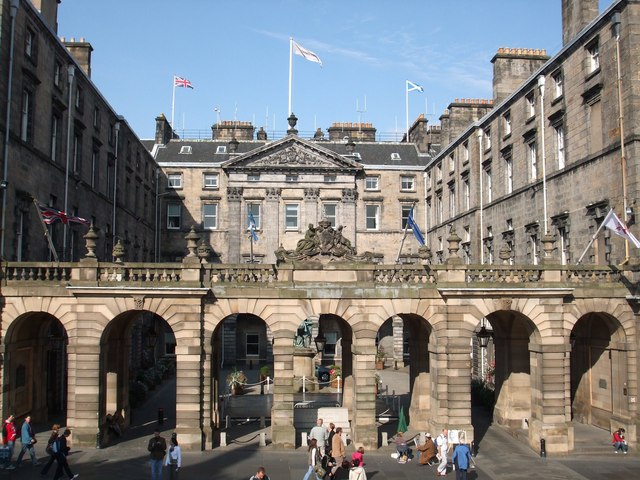
In 1694, the official name change to Mary Kings Close took place and in 1753, the Royal Exchange began construction. It largely covered over Mary King’s Close and three other closes. Instead of knocking down the closes completely, they just built over the closes. They were so cramped and all the houses so close together, it was completely doable. Then in 1853, the lower half of Mary Kings was destroyed as well as the rest of the Closes, and in 1902, Andrew Chesney, the last resident was forced out.
“What about the chilling ghost stories?” I hear you cry… Well, buckle up Creampuff…
Mary King’s Close is said to be the most haunted place in Scotland. The first incident of ghosts happened when Thomas Coltheart and his wife saw “apparitions and unknown phantom energies” in 1685.
The most well-known story of the close is that of Annie. Annie was a little girl who spoke (in ghost form) to Aiko Gibo, a Japanese psychic. Just off Allan’s Close, Aiko said “I cannot enter this room… It is too strong… there is a child beside me, her little hand is clutching my trouser leg. I… I cannot go into this room… she was separated from her parents. She wants to go home and see her family… her desire haunts this place very strongly.” Gibo did manage to go into the room, and she spoke to Annie near the fireplace. Annie told Aiko that she’d lost her favourite doll and was upset about it. So, Gibo went to a store and bought her back a doll and its now claimed that as long as the doll remains, the room won’t be disturbed by her. Now, people from far and wide bring a doll for little Annie, so she will never be alone again.
Another haunting, is that of the woman in black [and after the movie, I am not surprised people are scared of anyone with that name]. The woman in black is rumoured to be Mary King herself, but nobody really knows. She is said to stand at the top of the close and I remember being told when I was there, that she might appear in a photograph stood right behind the last member of the group. [which when I went, was of course me. Too say I was panicked, is an understatement.]
You can visit what’s left of Mary Kings Close and go on a tour around the underground labyrinth. It is one of the most exciting, most terrifying and best places I have been and would highly recommend it if you’re ever in Edinburgh. I hope you guys liked this blog and I hope you found out something you didn’t know about the maze underneath one of the best cities in the UK.
 Return Of The Famous Dead